Money · Assets · Ownership

The Ledger Room

Open conversations about money, assets, and ownership in a digital world.

Prof. Dr. Ulrich Bindseil × Benjamin Duve

Money is changing form. So are assets, markets, claims, and trust.

This is not only a technology story. It touches how people save, pay, invest, borrow, hold claims, use public and private money, access markets, protect privacy, and rely on institutions. Each episode aims to help you understand a little more, whether an aspect, a tradeoff, or an easily missed consequence of a choice.

Open discussion Argue every vantage point Ask hard questions
The Ledger Room series cover

Episode 001 · In preparation

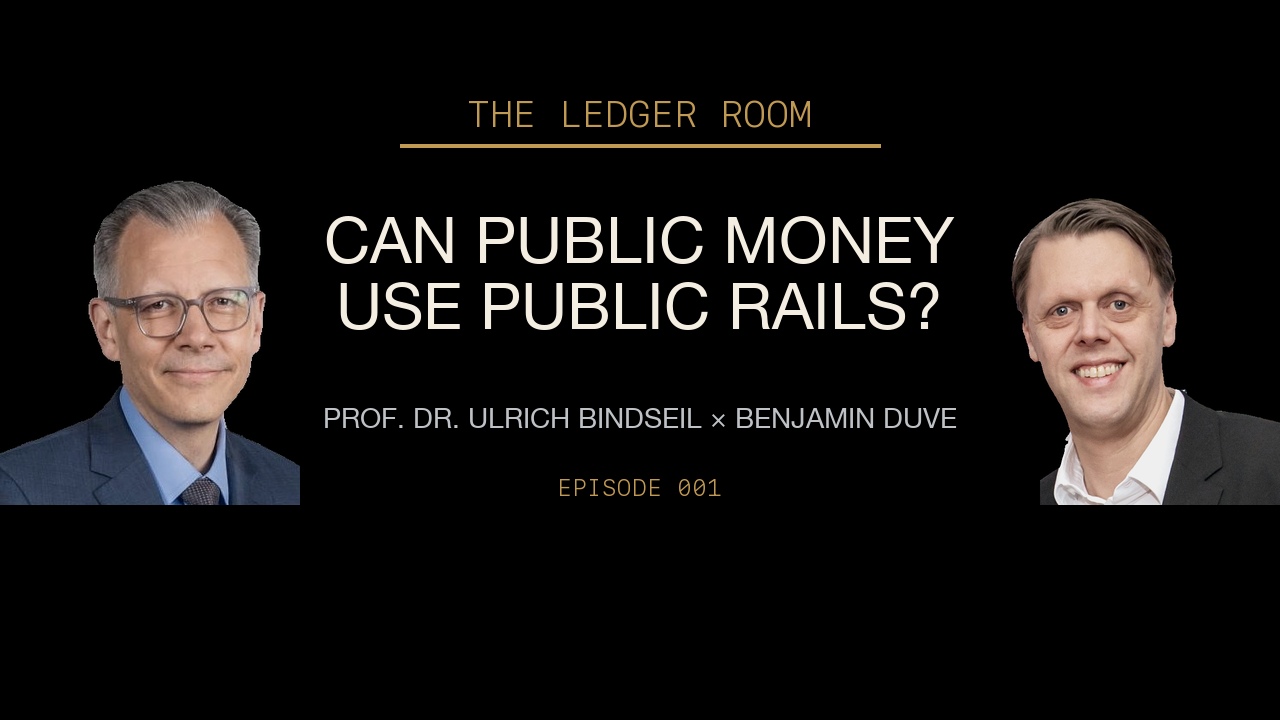
Can Public Money Use Public Rails?

Prof. Dr. Ulrich Bindseil × Benjamin Duve

In the first episode of The Ledger Room, Prof. Dr. Ulrich Bindseil and Benjamin Duve begin with their paper, Tokenizing Central Bank Money on Public Blockchains (SSRN 7348382; SUERF Policy Brief No 1572), then widen the conversation: what happens when public money, stablecoins, tokenized assets, and digital payment rails start competing and converging?

The opening question sets the tone: what is one thing open-network builders are right about that institutional side tends to underestimate?

Listen

Coming soon on Spotify, Apple Podcasts, and YouTube.

Episode 001 thumbnail: Can Public Money Use Public Rails?

Two perspectives

Two perspectives in the same room.

Prof. Dr. Ulrich Bindseil

Ulrich Bindseil has worked for Deutsche Bundesbank, the European Monetary Institute, and the European Central Bank. At the ECB, he served as Head of Risk Management, Director General of Market Operations, and Director General of Market Infrastructure and Payments. Ulrich Bindseil is Professor of Practice in Financial Infrastructure at Frankfurt School of Finance & Management and incoming Director of the Study Center Gerzensee, a foundation of the Swiss National Bank, on 1 January 2027.

His books include Monetary Policy Operations and the Financial System and Central Banking before 1800
A Rehabilitation
.

Benjamin Duve

Benjamin Duve has spent more than two decades in corporate and institutional banking, with leadership roles across payments, custody, tokenization, and digital assets at Commerzbank, BNY, and Galaxy.

His recent work has focused on strategy, partnerships, and commercial growth as traditional finance converges with DLT-based infrastructure. In 2024, he worked at the ECB’s Directorate General Market Infrastructure and Payments on the tokenization of central bank money, contributing to the approach later announced as the Eurosystem’s Appia initiative.

In the spirit of an open discussion, the hosts speak in a personal capacity. The views expressed are their own and do not represent or reflect the positions of any current or former employer or engagement. Nothing on this site is investment, legal, or financial advice.

Why this room exists

The future monetary and asset stack is being rebuilt in public.

Stablecoins, tokenized securities, central bank digital currencies, and public blockchains are no longer separate topics. Together they are changing how money and assets are issued, held, moved, and settled.

Behind the technology are choices for central banks, governments, banks, issuers, and users. They have to decide who may access a rail, who governs the ecosystem, who stands behind a claim, how privacy and compliance are balanced, and what happens under stress.

The series opens with the two hosts. After that, each episode adds a guest who looks at these questions from a different seat.

The essence

The design choices matter.

Every new monetary design makes choices visible about who can access it, who stands behind it, how trust is created, what users actually own, how privacy and compliance are balanced, and what happens when systems are placed under stress.

OWNERSHIP

What do you actually own?

Whether it is money or an asset, a token can mean direct ownership, a beneficial claim, a contract, economic exposure, or permissioned access. The label rarely tells you which.

ISSUER

Who stands behind the token, and who may issue it where?

A claim is only as strong as its issuer. Backing, governance, regulation, and transparency decide what the promise is worth. Where it may be issued, under which licence, and in which jurisdiction, decides who can actually hold it.

RAILS AND ECOSYSTEM

Who owns the rails, what is built around them, and who can access them?

Every token depends on infrastructure someone else governs, from the network and its validators to the wallets, custodians, bridges, and liquidity around it. Controlling the token is not the same as controlling the network underneath it, or who can access it.

FINALITY

When is a transfer really final?

A transfer of money or assets can be confirmed on-chain and still be open in law. Legal certainty decides whether either can work at scale, and it is still open whether decentralized consensus can provide that finality on its own.

TRUST

Who do you actually have to trust?

Traditional finance anchors trust in institutions, in central banks for money and in registrars and custodians for assets. DeFi promises to replace that trust with code and consensus. In practice every model trusts someone, whether the issuer, the validators, a trust anchor like a central bank, the developers, or the wallet acting on your behalf.

ECONOMICS

Where does the value flow?

Stablecoins, tokenized bonds, collateral, and deposits all raise practical questions about reserves, yield, fees, and incentives.